Chapter 2 Lie Groups
Definition 2.1 (Lie Group) A Lie group is a smooth manifold \(G\) which is also a group, such that the group multiplication \[\mu: G \times G \to G, \quad (g,h) \mapsto gh\] and the inverse map \[\iota: G \to G, \quad g \mapsto g^{-1}\] are both smooth.
Example 2.1 Let \(G = \mathbb{R} \times \mathbb{R} \times S\), equipped with the group operation \[(x_1, y_1, \lambda_1) \cdot (x_2, y_2, \lambda_2) = (x_1 + x_2,\, y_1 + y_2,\, e^{ix_1y_2}\lambda_1 \lambda_2). \text{ and } \] \[(x,y,\lambda)^{-1}=\left(-x,\; -y,\; e^{ixy}\lambda^{-1}\right)\]$$ Then \(G\) is a Lie group.
Definition 2.2 Let \(A_m\) be a sequence of complex matrices in \(\mathbb{M}_n(\mathbb{C})\). We say that \(A_m \to A\) (i.e., \(A_m\) converges to a matrix \(A\)) if each entry of \(A_m\) converges to the corresponding entry of \(A\) as \(m \to \infty\); In other words, \[(A_m)_{jk} \to A_{jk} \quad \text{for all } 1 \leq j, k \leq n.\]
Definition 2.3 (Matrix Lie Group) A matrix Lie group is a subgroup \(G \subseteq \mathrm{GL}(n, \mathbb{C})\) with the following property: If \(\{A_m\}\) is any sequence of matrices in \(G\) such that \(A_m \to A\), then either \(A \in G\) or \(A\) is not invertible.
Example 2.2 (Example of Matrix Linear Groups)
- General Linear Groups over \(\mathbb{C}\) and \(\mathbb{R}\).
- \(GL_n(\mathbb{C})\) is sub group itsself.
- if \(A_m\) is a sequence of matrices in \(GL_n(\mathbb{C}\) and \(A_m\) converges to \(A\), then by the definition of \(GL_n(\mathbb{C}\), either \(A\) is in \(GL_n(\mathbb{C}\),or \(A\) is not invertible.
- Special linear Groups over \(\mathbb{C}\) and \(\mathbb{R}\).
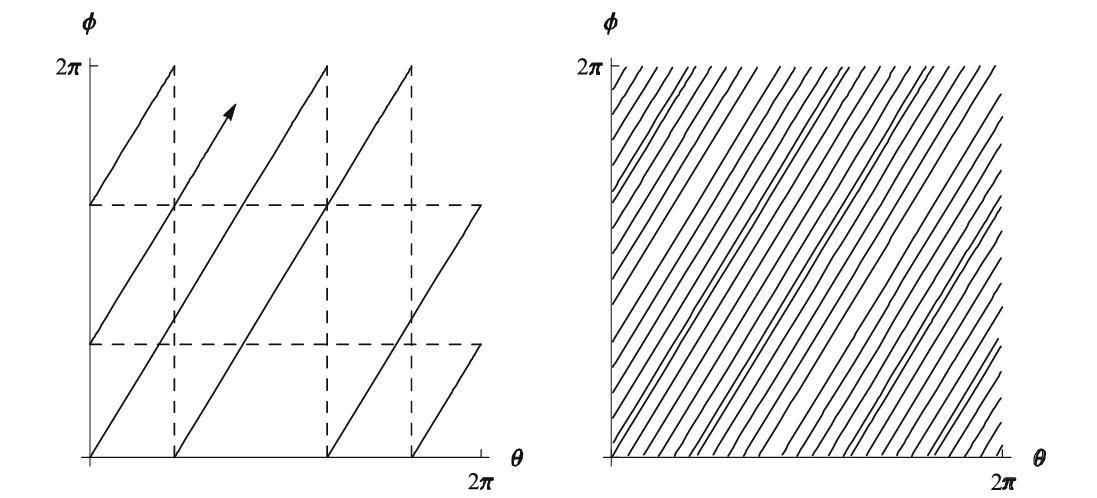
Example 2.3 (Non example) Let \(\alpha \in \mathbb{R} \setminus \mathbb{Q}\), and define the subgroup \(G \subseteq \mathrm{GL}(2, \mathbb{C})\) consisting of matrices of the form
\[G = \left\{ \begin{pmatrix} e^{it} & 0 \\ 0 & e^{i\alpha t} \end{pmatrix} : t \in \mathbb{R} \right\}.\]
Clearly, \(G\) is a subgroup of \(\mathrm{GL}(2, \mathbb{C})\). The closure of \(G\) in the standard topology is the torus subgroup
\[\overline{G} = \left\{ \begin{pmatrix} e^{i\theta} & 0 \\ 0 & e^{i\phi} \end{pmatrix} : \theta, \phi \in \mathbb{R} \right\} = \left\{ \begin{pmatrix} z_1 & 0 \\ 0 & z_2 \end{pmatrix} : |z_1| = |z_2| = 1 \right\},\]
which is a compact Lie group. Since \(G\) is not closed, it fails the closure condition required for matrix Lie groups. Thus, \(G\) is not a matrix Lie group.
This subgroup \(G\) is sometimes referred to as an irrational line in a torus.
I had problem synchronized with yellow dots. Sorry about that.
–
Definition 2.4 (Lie Group homomorphism and Isomorphisms) Let \(G\) and \(H\) be matrix Lie groups. A map \(\varphi : G \to H\) is called a Lie group homomorphism if
- \(\varphi\) is a group homomorphism, and
- \(\varphi\) is continuous.
If, in addition, \(\varphi\) is one-to-one and onto, and the inverse map \(\varphi^{-1}\) is continuous, then \(\varphi\) is called a Lie group isomorphism.
Example 2.4 (Examples of Lie Group Homomorphisms)
The determinant is a homomorphism \(\det : \mathrm{GL}_n(\mathbb{C}) \to \mathbb{C}\setminus \{0\}\)
The map \(\varphi : \mathbb{R} \to \mathrm{SO}(2)\), defined by \[\varphi(t) = \begin{pmatrix} \cos t & -\sin t \\ \sin t & \cos t \end{pmatrix}\] is also a group homomorphism.