class: center, middle, inverse, title-slide .title[ # Lie Groups and Lie Algebra ] .author[ ### Ashan De Silva ] .institute[ ### Department of Mathematics<br>University of Manitoba ] .date[ ### 2026-02-08 ] --- <style type="text/css"> .definition-box { background-color: #eee8d5; border-left: 5px solid #dc322f; padding: 20px; margin: 20px 0; border-radius: 5px; } .theorem-box { background-color: #eee8d5; border-left: 5px solid #dc322f; padding: 20px; margin: 20px 0; border-radius: 5px; } .example-box { background-color: #fdf6e3; border-left: 5px solid #268bd2; padding: 20px; margin: 20px 0; border-radius: 5px; } .insight-box { background-color: #fdf6e3; border-left: 5px solid #859900; padding: 15px; margin: 15px 0; border-radius: 5px; } .remark-code { font-size: 18px; } .small-text { font-size: 18px; } .large-number { font-size: 48px; font-weight: bold; color: #dc322f; } .two-column { display: grid; grid-template-columns: 1fr 1fr; gap: 30px; } .column-left { padding: 20px; background-color: #eee8d5; border-radius: 8px; border-left: 3px solid #268bd2; } .column-right { padding: 20px; background-color: #eee8d5; border-radius: 8px; border-left: 3px solid #859900; } h3 { margin-top: 10px; margin-bottom: 15px; } .math-large { font-size: 24px; } .venn-area { position: relative; width: 500px; height: 300px; margin: 0 auto; } .v-circle { width: 250px; height: 250px; border-radius: 50%; position: absolute; top: 25px; display: flex; align-items: center; font-weight: bold; font-size: 22px; /* Removed background-color, added border */ border: 2px solid #002b36; background-color: transparent; } .v-left { left: 50px; justify-content: flex-start; padding-left: 30px; color: #002b36; } .v-right { right: 50px; justify-content: flex-end; padding-right: 20px; color: #002b36; } .v-label { position: absolute; top: 50%; left: 50%; transform: translate(-50%, -50%); font-weight: bold; font-size: 26px; color: #dc322f; /* Using your theme's red for the central label to make it pop */ text-align: center; z-index: 10; line-height: 1.1; } </style> # Table of Contents .large[ 1. **Introduction to Lie Groups** *Definition and basic properties* 2. **Examples of Lie Groups** *Classical groups and matrix groups* 3. **Lie Algebras** *The tangent space perspective* 4. **The Exponential Map** *Connecting groups and algebras* 5. **Applications** *Physics and geometry* ] --- class: inverse, center, middle # What Are Lie Groups? ### Combining Geometry and Algebra <img src="https://upload.wikimedia.org/wikipedia/commons/thumb/1/14/E8Petrie.svg/330px-E8Petrie.svg.png" style="width: 300px; margin-top: 20px;" /> .footnote[Image Credit: Wikeipedia] --- # Definition: Lie Group .definition-box[ **DEFINITION** A **Lie group** is a smooth manifold `\(G\)` which is also a group, such that: 1. The group multiplication map is smooth: `\(\mu: G \times G \to G, \quad (g,h) \mapsto gh\)` 2. The inverse map is smooth: `\(\iota: G \to G, \quad g \mapsto g^{-1}\)` ] .insight-box[ 💡 **Key Insight** Lie groups blend continuous symmetry (manifold structure) with algebraic operations (group structure). ] --- # Intuitive Understanding .two-column[ .column-left[ ### As a Manifold - Smooth, continuous space - Has tangent vectors - Locally looks like `\(\mathbb{R}^n\)` ] .column-right[ ### As a Group - Multiplication is smooth - Has identity and inverses - Algebraic structure ] ] <div class="venn-area"> <div class="v-circle v-left" style="border: 2px solid #586e75;">Groups</div> <div class="v-circle v-right" style="border: 2px solid #586e75;">Manifolds</div> <div class="v-label">Lie<br>Groups</div> </div> <br clear="all"> --- # Example 1: The Circle Group `\(S^1\)` <!-- .example-box[ Let `\(G = \mathbb{R} \times \mathbb{R} \times S\)`, equipped with the group operation `$$(x_1, y_1, \lambda_1) \cdot (x_2, y_2, \lambda_2) = (x_1 + x_2,\, y_1 + y_2,\, e^{ix_1y_2}\lambda_1 \lambda_2). \text{ and }$$` `$$(x,y,\lambda)^{-1}=\left(-x,\; -y,\; e^{ixy}\lambda^{-1}\right)$$` Then `\(G\)` is a Lie group. ]--> .example-box[ **EXAMPLE 1** The unit circle in the complex plane: `\(S^1 = \{z \in \mathbb{C} : |z| = 1\}=\{e^{i\theta}:0\leq \theta <2\pi\}\)` - **Group operation:** `\(z_1 \cdot z_2 = e^{i\theta_1} \cdot e^{i\theta_2} = e^{i(\theta_1+\theta_2)}\)` - **Inverse:** `\((e^{i\theta})^{-1} = e^{-i\theta}\)` ] .insight-box[ **Geometric View:** Multiplication = Rotation Rotating by angle `\(\theta_1\)` then by angle `\(\theta_2\)` equals rotating by angle `\(\theta_1 + \theta_2\)` `\(S^1\)` models rotational symmetry! ] --- # Example 2: General Linear Group `\(GL(n,\mathbb{R})\)` .example-box[ **EXAMPLE 2** The group of invertible `\(n \times n\)` real matrices: `$$GL(n,\mathbb{R}) = \{A \in \text{Mat}(n \times n, \mathbb{R}) : \det(A) \neq 0\}$$` ] **Properties:** - **Manifold structure:** Open subset of `\(\mathbb{R}^{n^2}\)` (condition `\(\det(A) \neq 0\)` defines open set) - **Group operation:** Matrix multiplication - **Identity:** `\(I_n\)` (identity matrix) - **Inverse:** `\(A^{-1}\)` (matrix inverse) - **Dimension:** `\(n^2\)` as a manifold --- <!--- # Classical Lie Groups | Symbol | Name | Definition | Dimension | |--------|------|------------|-----------| | `\(SL(n,\mathbb{R})\)` | Special Linear Group | Matrices with `\(\det(A) = 1\)` | `\(n^2 - 1\)` | | `\(O(n)\)` | Orthogonal Group | `\(A^T A = I\)` (preserves inner product) | `\(\frac{n(n-1)}{2}\)` | | `\(SO(n)\)` | Special Orthogonal Group | `\(O(n)\)` with `\(\det(A) = 1\)` (rotations) | `\(\frac{n(n-1)}{2}\)` | | `\(U(n)\)` | Unitary Group | `\(A^* A = I\)` in `\(\mathbb{C}^{n \times n}\)` | `\(n^2\)` | | `\(Sp(2n,\mathbb{R})\)` | Symplectic Group | Preserves symplectic form | `\(n(2n+1)\)` | <br> .small-text[ These groups appear throughout mathematics and physics as fundamental symmetry groups. ] ---> # Intutive Idea Cont ... 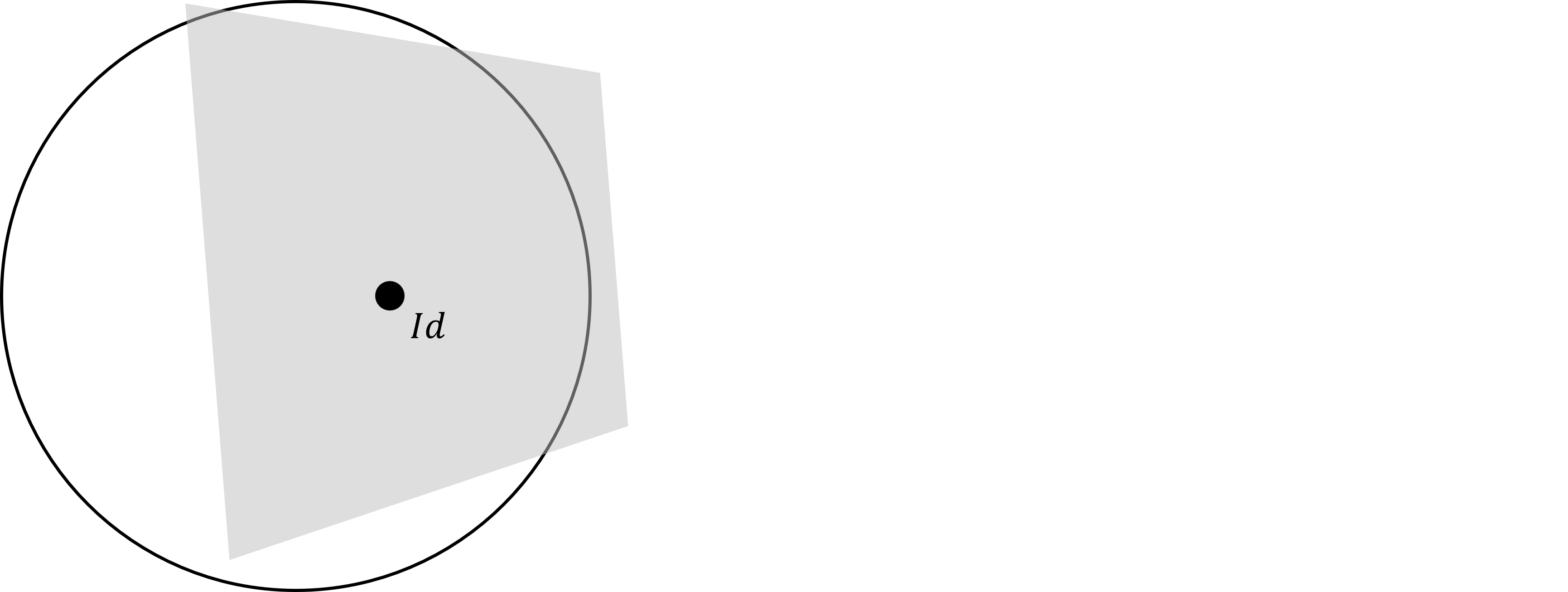 --- # Intutive Idea Cont ...  --- # Intutive Idea Cont ...  --- # Intutive Idea Cont ...  --- # Intutive Idea Cont ... 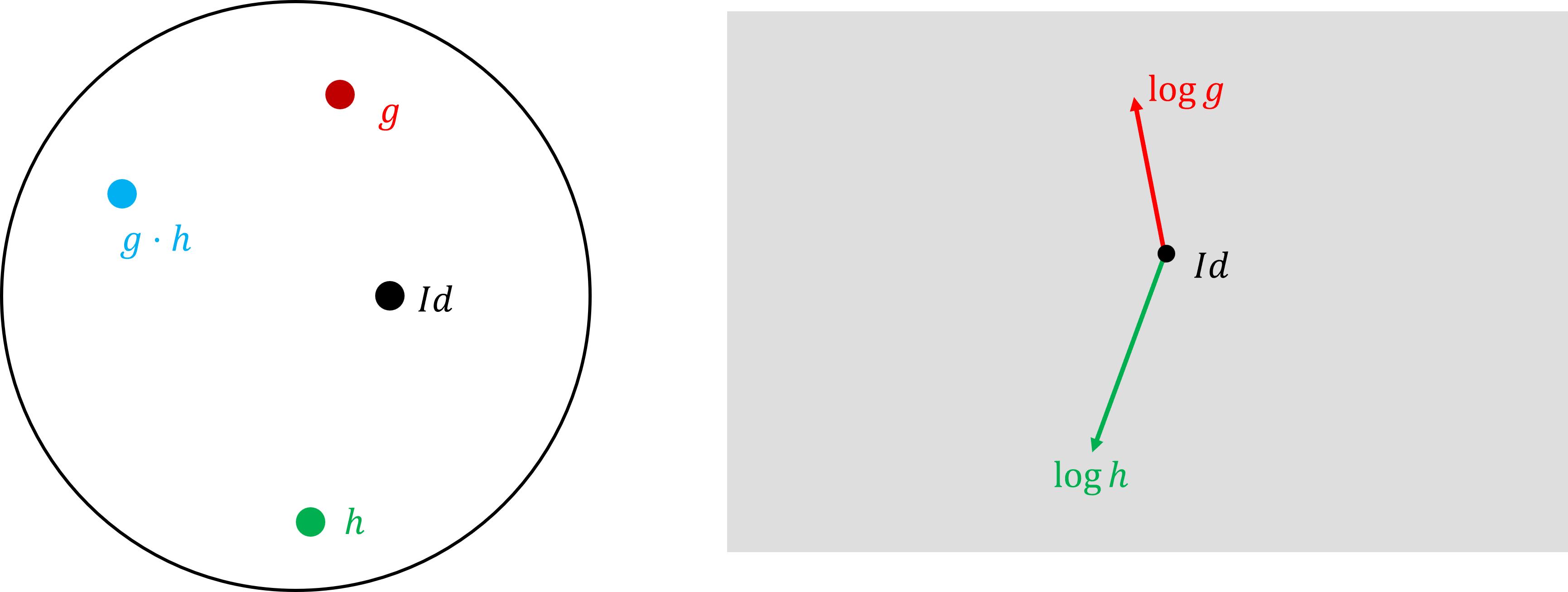 --- # Intutive Idea Cont ... 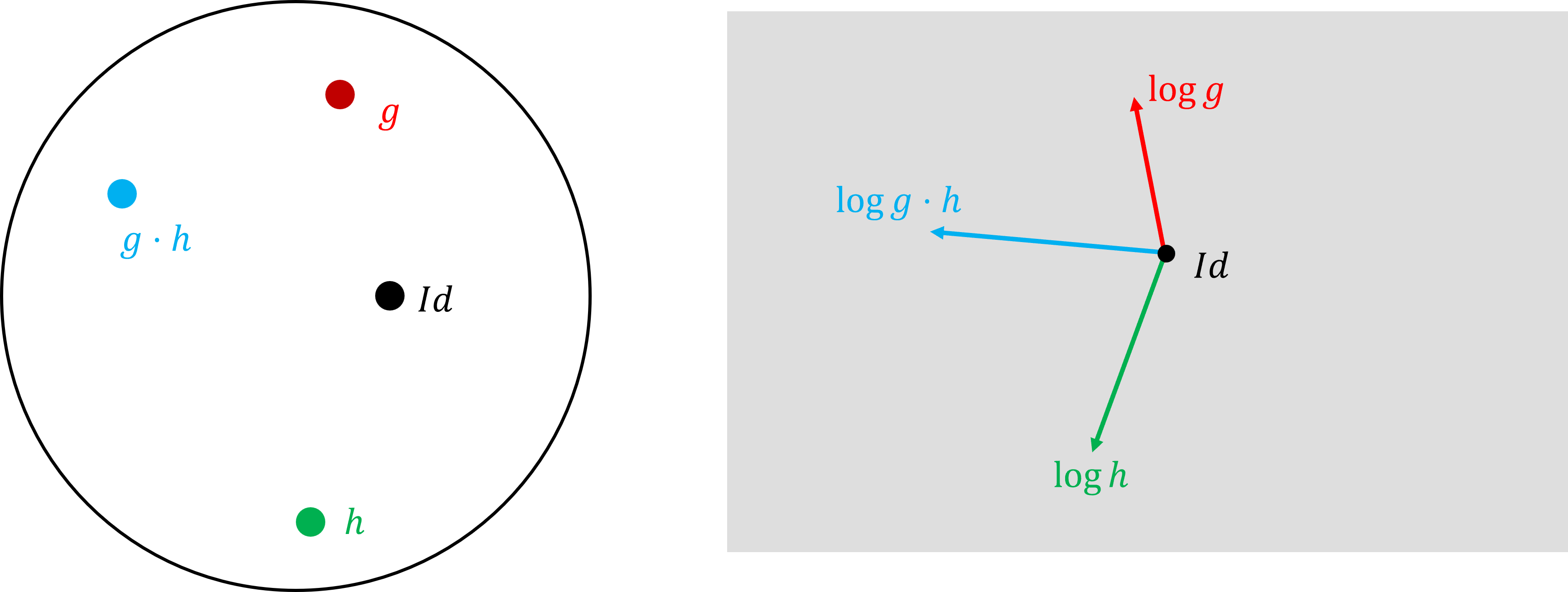 --- #Intutive Idean Cont ... <img src="pic/Picture7.png" width="50%"> -- `$$Z= X + Y + \frac{1}{2}[X,Y]+ \frac{1}{12}[X,[X,Y]]- \frac{1}{12}[Y,[X,Y]]- \frac{1}{24}[Y,[X,[X,Y]]]+ \cdots$$` -- This formula is called **Baker–Campbell–Hausdorff Formula** --- class: inverse, center, middle # Lie Algebras ### The Infinitesimal Structure --- ## Intuitive Idea -- |Curved Space|Flat Space| |:-:|:-:| |<img src="https://imgs.search.brave.com/LYPN50ihJGwGZAJBFhcKNHLmgFnCjVQ02hhm99t64to/rs:fit:860:0:0:0/g:ce/aHR0cHM6Ly90aHVt/YnMuZHJlYW1zdGlt/ZS5jb20vYi9nbG9i/ZS03MzQ2MTc2Lmpw/Zw" width="200px" />|<img src="https://imgs.search.brave.com/H28MCU5JiRpf5zL7AshdyinUh6PesIuL0cWnZBWm3lc/rs:fit:860:0:0:0/g:ce/aHR0cHM6Ly93b3Js/ZG1hcGJsYW5rLmNv/bS93cC1jb250ZW50/L3VwbG9hZHMvMjAy/My8wNy9Mb25naXR1/ZGUtYW5kLUxhdGl0/dWRlLU1hcC1NaWxs/ZXItUHJvamVjdGlv/bi53ZWJw" width="200px" />| |Lie Group|Lie Algebra| --- # Definition: Lie Algebra .definition-box[ **DEFINITION** A **Lie algebra** is a vector space `\(\mathfrak{g}\)` equipped with a bilinear operation `$$[\cdot, \cdot]: \mathfrak{g} \times \mathfrak{g} \to \mathfrak{g}$$` called the **Lie bracket**, satisfying: 1. **Antisymmetry:** `\([X, Y] = -[Y, X]\)` 2. **Jacobi identity:** `\([X, [Y, Z]] + [Y, [Z, X]] + [Z, [X, Y]] = 0\)` ] .insight-box[ **Connection to Lie Groups** For a Lie group `\(G\)`, its Lie algebra `\(\mathfrak{g} = T_e G\)` is the tangent space at the identity. The Lie bracket captures how tangent vectors "fail to commute" in the group. ] --- # Example: Lie Algebra of `\(GL(n,\mathbb{R})\)` .example-box[ The Lie algebra of `\(GL(n,\mathbb{R})\)` is: `$$\mathfrak{gl}(n,\mathbb{R}) = \text{Mat}(n \times n, \mathbb{R})$$` (all `\(n \times n\)` real matrices) ] **Lie Bracket:** The Lie bracket is the **matrix commutator**:$[A, B] = AB - BA$ **Verification of Properties:** - **Antisymmetry:** `\([A, B] = AB - BA = -(BA - AB) = -[B, A]\)` - **Jacobi identity:** Can be verified by direct computation --- # The Exponential Map .theorem-box[ **THEOREM** The exponential map `\(\exp: \mathfrak{g} \to G\)` is defined by: `$$\exp(X) = e^X = I + X + \frac{X^2}{2!} + \frac{X^3}{3!} + \cdots$$` ] .two-column[ .column-left[ ### Key Properties 1. `\(\exp(0) = e\)` (identity) 2. `\(\exp(tX)\)` is a 1-parameter subgroup for each `\(X \in \mathfrak{g}\)` 3. `\(\frac{d}{dt}\exp(tX)\big|_{t=0} = X\)` 4. `\(\exp\)` is a local diffeomorphism near `\(0 \in \mathfrak{g}\)` ] .column-right[ ### Geometric Meaning The exponential map takes: **Tangent vectors at identity** (infinitesimal symmetries) ↓ **Group elements** (actual symmetries) ] ] --- # Example: Exponential of Matrices **Example 1: Diagonal Matrix** If `\(X = \text{diag}(\lambda_1, \lambda_2, \ldots, \lambda_n)\)`, then: `$$\exp(X) = \text{diag}(e^{\lambda_1}, e^{\lambda_2}, \ldots, e^{\lambda_n})$$` <br> **Example 2: Rotation Matrix** For the `\(2 \times 2\)` skew-symmetric matrix: `$$X = \begin{pmatrix} 0 & \theta \\ -\theta & 0 \end{pmatrix}, \quad \exp(X) = \begin{pmatrix} \cos\theta & \sin\theta \\ -\sin\theta & \cos\theta \end{pmatrix}$$` This gives a rotation by angle `\(\theta\)`! .insight-box[ The exponential map converts infinitesimal rotations into actual rotations! ] --- # Applications of Lie Theory .example-box[ ### Physics - Quantum mechanics: Angular momentum, spin - Particle physics: Gauge theories, Standard Model - General relativity: Lorentz group, spacetime symmetries ] .example-box[ ### Differential Geometry - Isometry groups of Riemannian manifolds - Holonomy groups and parallel transport - Symmetric spaces and homogeneous spaces ] .example-box[ ### Control Theory - Robotics: Configuration spaces - Nonlinear control systems - Optimal control on manifolds ] --- # Summary ### Key Takeaways 1. **Lie groups** combine smooth manifold structure with group structure 2. **Classical examples:** `\(GL(n,\mathbb{R})\)`, `\(SO(n)\)`, `\(SU(n)\)` — fundamental in mathematics and physics 3. **Lie algebras** are the "infinitesimal" version — tangent space at identity 4. **The exponential map** connects Lie algebras to Lie groups 5. **Applications** span physics, geometry, control theory, and beyond <br> .insight-box[ 📚 **Further Study:** Representation theory, Homogeneous spaces, Lie group cohomology ] --- class: inverse, center, middle # Thank You! ### Questions? **Ashan De Silva** Department of Mathematics University of Manitoba --- # References and Further Reading .small-text[ **Recommended Textbooks:** - Stillwell, J. (2008). *Naive Lie Theory*. Springer. - Hall, B. (2015). *Lie Groups, Lie Algebras, and Representations*. Springer. - Knapp, A. (2002). *Lie Groups Beyond an Introduction*. Birkhäuser. **Online Resources:** - nLab: Lie group (https://ncatlab.org/nlab/show/Lie+group) - MIT OpenCourseWare: Topics in Lie Theory - University of Chicago: Lie Groups Notes # Visualizing and its Lie Algebra .pull-left[ * This is the Lie Group (the unit circle). -- * We pick the identity element . -- * The Lie Algebra is the tangent space . ] .pull-right[ <img src="pre_files/figure-html/plot-step1-1.png" alt="" width="100%" /> -- <img src="pre_files/figure-html/plot-step2-1.png" alt="" width="100%" style="position: absolute; top: 120px; right: 50px;" /> -- <img src="pre_files/figure-html/plot-step3-1.png" alt="" width="100%" style="position: absolute; top: 120px; right: 50px;" /> ]